ADAMS: Chrystia Freeland's “Coming Weeks” Resignation Isn't Good Enough
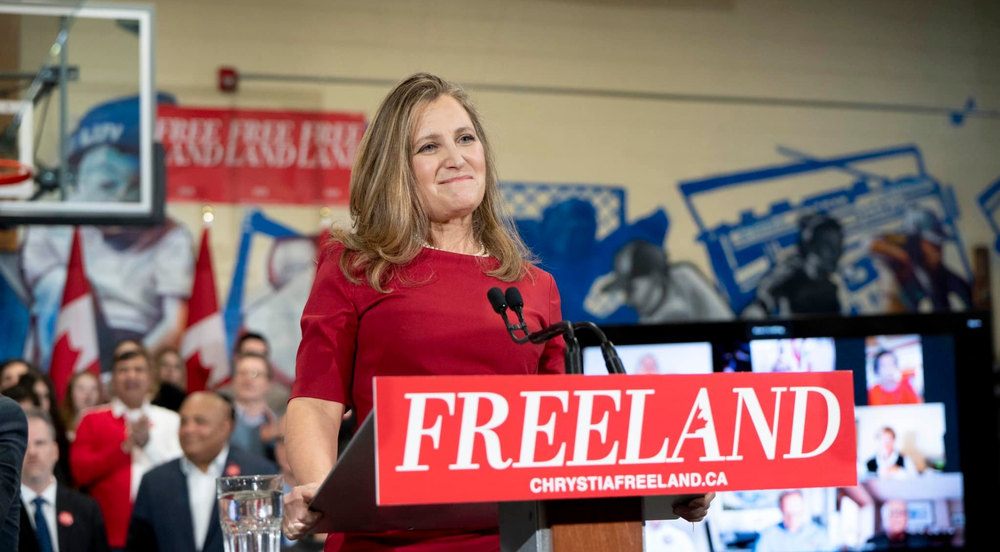
Chrystia Freeland wants Canadians to believe she’s doing the noble thing.
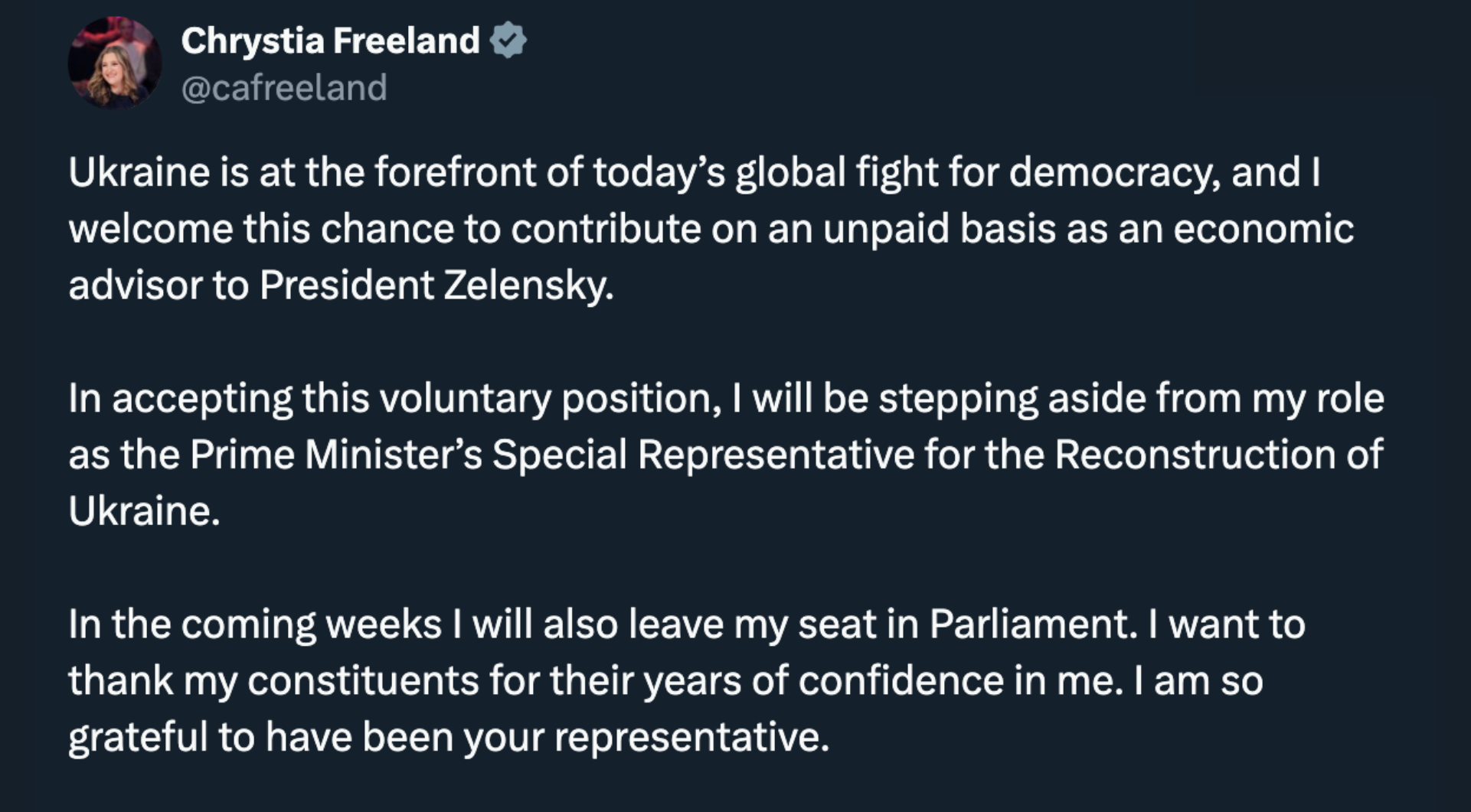
First, we were told she would serve as an economic adviser to President Zelenskyy on an unpaid basis. Then, after a public backlash that cut across party lines, she released a carefully worded statement: she will step aside as Canada’s special representative for Ukraine, and “in the coming weeks” she will also resign her seat in Parliament.
We are supposed to hear that and say: crisis averted, all good now, move on.
No. Not even close.
Because as of right now, Chrystia Freeland is still:
- A Liberal Member of Parliament
- Drawing a taxpayer-funded salary
- Holding full voting power in the House of Commons
…and at the same time preparing to advise a foreign government that is heavily reliant on Canadian funding, arms, and diplomatic support.
You can dress it up in diplomatic language. You can call it “voluntary” and “unpaid.” But you can't escape the basic truth:
You cannot work for two states at once and pretend there is no conflict of interest.
The cooling-off rules exist for a reason
Under Canada's Conflict of Interest Act, former ministers don't just get to walk out of Cabinet on Friday and start monetizing their contacts on Monday. There is a two-year cooling-off period for a reason.
During that time, ex-ministers are supposed to stay away from:
- Taking paid jobs, contracts, or board appointments with entities they had “direct and significant official dealings” with in their last year in office.
- Making official representations on behalf of those entities to the Canadian government.
Why? Because Canadians are not stupid. We know how the “revolving door” works. You leave office, call up the same people you used to sit across from in Cabinet or at the PMO, and cash in on insider access that ordinary citizens will never have.
Freeland resigned from Cabinet in September 2025. That's when the clock started.
But she didn't step away from public life. She stayed on as an MP. She accepted a powerful role as special representative for Ukraine's reconstruction, under the authority of the same Liberal government she helped build. She remained a central figure in shaping Canada's Ukraine policy.
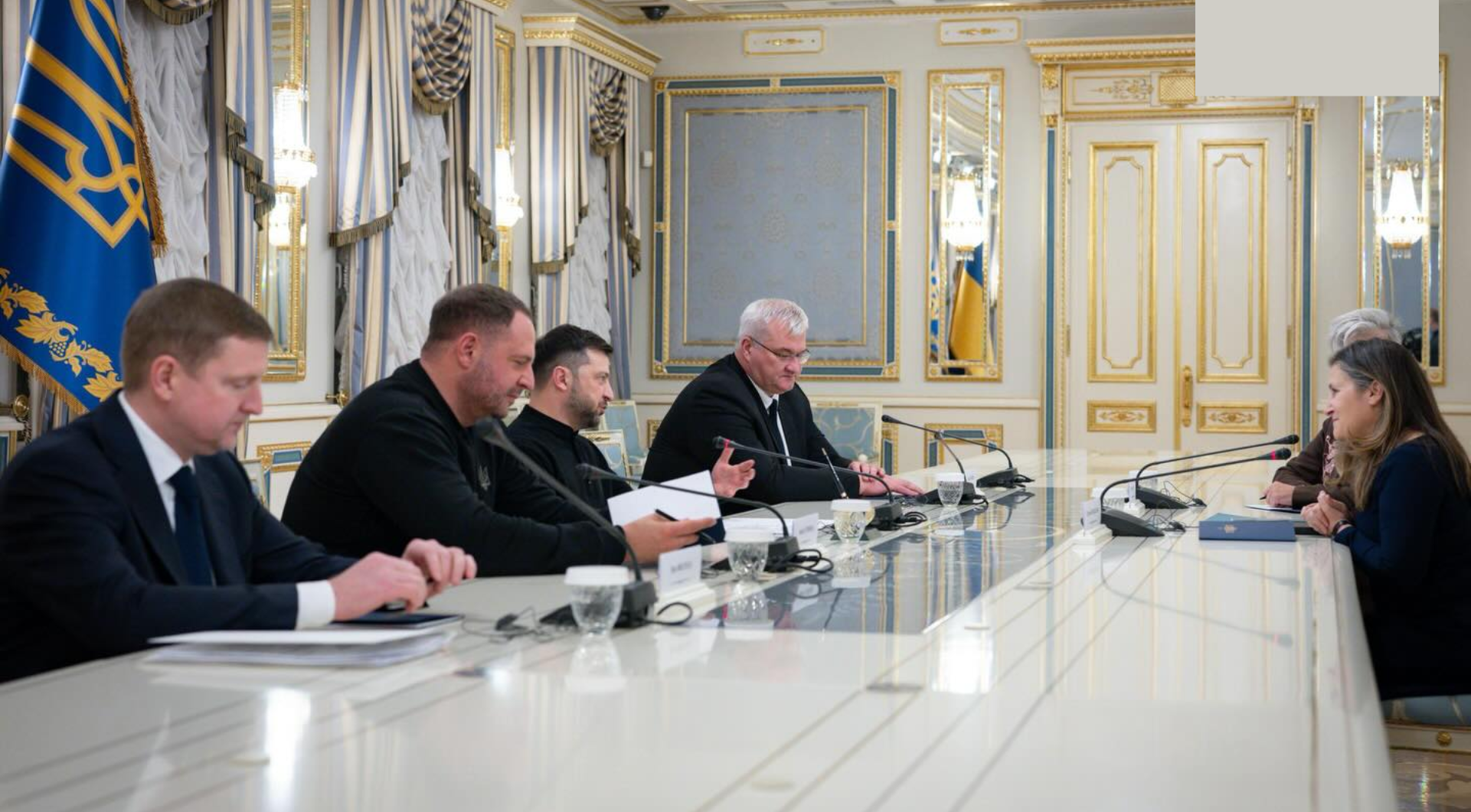
Now, barely days into that cooling-off window, she's going to advise Ukraine's president directly.
Technically, lawyers will argue that the Act focuses on paid employment and formal contracts. Technically, they'll say this “voluntary, unpaid” advisory role threads the needle.
But Canadians don't live in the world of lawyerly technicalities. We live in the real world, where:
- “Unpaid” roles often come with perks, access, travel, housing, staff, and status;
- Influence can be exercised without a salary line on a spreadsheet;
- And there is no way for Canadians to see what informal benefits are offered down the line.
The law may be written narrowly. The spirit behind it is not. It is supposed to stop exactly this kind of blurred loyalty and quiet backroom influence.
“In the coming weeks” is not accountability
Freeland's defenders are already saying: “Relax, she's resigning.”
Read her words carefully.
“In the coming weeks I will also leave my seat in Parliament.”
That's not a resignation. That's a promise of a resignation, on a timeline she controls, after she has already accepted a foreign advisory role.
If an ordinary Canadian tried this stunt with their employer, they'd be out the door by the end of the day. Imagine telling your boss:
"By the way, I've accepted a senior position with another company that does business with you. Don't worry, I'll quit here in a few weeks when it suits me."
You wouldn't be gently applauded for your service. You'd be cleared out of your office.
Freeland, on the other hand, gets to keep her seat, her paycheque, and her vote. She will continue to sit in a Parliament that will inevitably be asked to approve new rounds of aid, weapons, loans, and reconstruction support for the very government she is now advising.
That isn't just bad optics. That is a live, ongoing conflict of interest.
“Unpaid” is not a magic shield
We are told not to worry because the advisory position is unpaid.
Since when did the word “unpaid” magically erase the possibility of influence, perks, or future rewards?
There are a hundred ways to thank a helpful foreign adviser that don't show up as “salary” on a public disclosure form: preferred access, high-level introductions, speaking platforms, honours, appointments, and yes, generous expense coverage.
Most Canadians don't get taxpayer-funded travel, VIP treatment, and a foreign president's grateful ear as a side gig. They get told to work overtime and be grateful they still have a job.
The idea that this is all squeaky-clean because no one is cutting her a monthly paycheque is an insult to the intelligence of the people footing the bill for everything else.
Elected by Canadians, not by Kyiv
Here is the heart of the issue, and it has nothing to do with whether you “support Ukraine” or not.
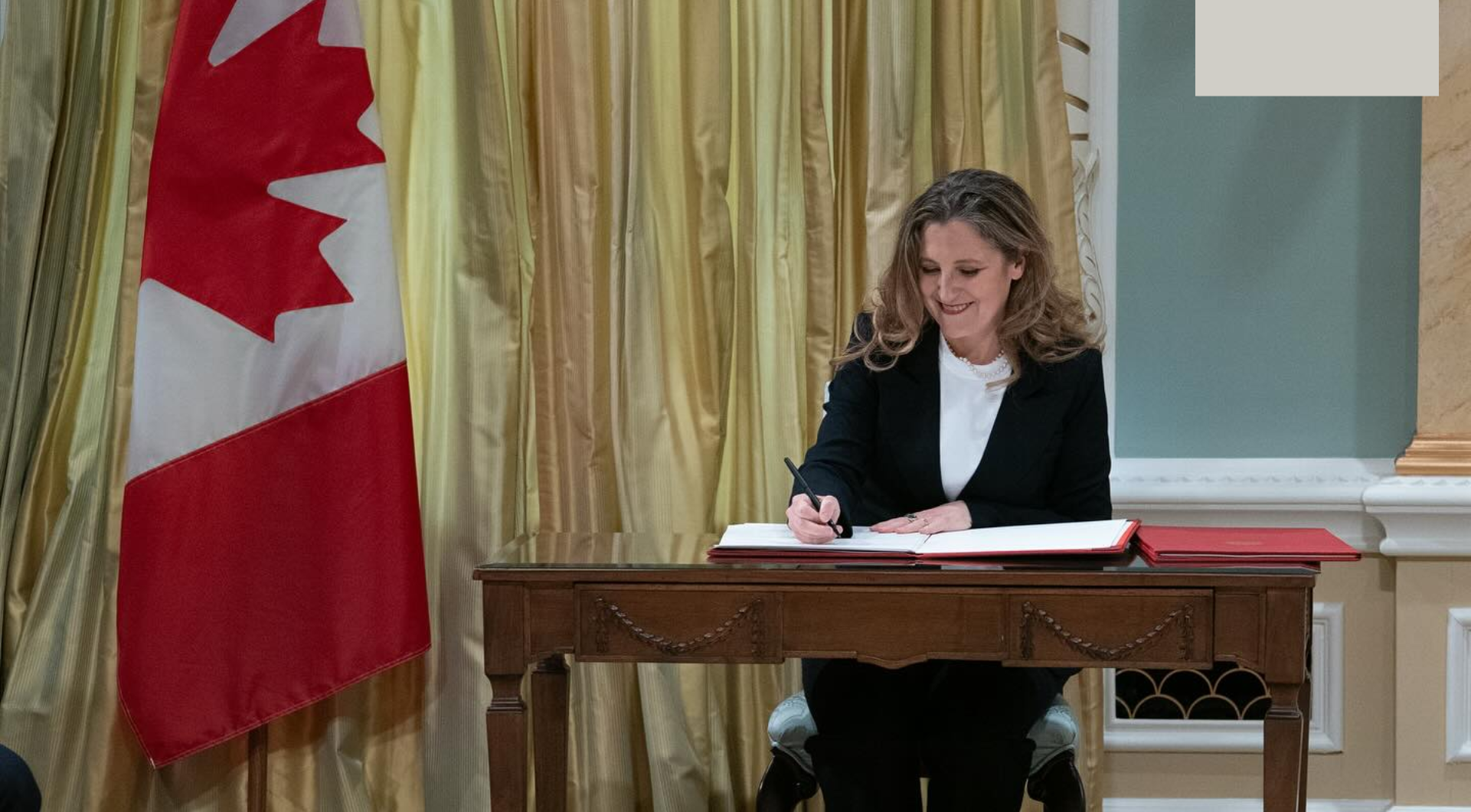
Chrystia Freeland was not elected by Ukrainians. She was elected by Canadians in a Canadian riding, under a Canadian flag, to serve in a Canadian Parliament.
If she wants to step away from that responsibility and devote her energy to another country, that is her right. Nobody is saying she should be chained to Ottawa for life.
But there is a correct order of operations:
- Resign your seat.
- End your Canadian government appointments.
- Then take on the foreign advisory role.
Freeland did it backwards. She accepted the foreign role first, waited to see if Canadians would swallow it, then issued a carefully calibrated promise to leave “in the coming weeks” once it became clear that even many of her own supporters couldn't defend the arrangement.
That is not leadership. That is damage control.
Canadians deserve better than this revolving-door elite politics
If a small-town councillor tried to sit on council while advising a developer in private, there would be outrage. Ethics commissioners would be called. Local papers would be full of it.
At the federal level, when a long-time Liberal powerbroker tries to sit as an MP while advising a foreign president whose government is one of the biggest recipients of Canadian aid, we are told to calm down, that it's all “voluntary” and “temporary.”
Enough.
If the Conflict of Interest Act is too weak to catch this, then the Act needs to be strengthened. If the Ethics Commissioner won't speak up, Canadians need to demand better.
Because this isn't about one politician or one country. It's about a basic principle:
Our representatives should not be serving two masters.
Chrystia Freeland should not still be drawing a salary and voting in our House of Commons while onboarding into a foreign government’s inner circle. Not for “weeks.” Not for a day. Not for a single minute longer.
She should resign immediately, and Parliament should make sure no one can play this game again.
Canadians have put up with enough of the political aristocracy treating conflict-of-interest rules as clever puzzles to be solved instead of guardrails to be respected. This time, we don't need more spin. We need a clear line:
You work for Canada, or you don't.
This piece was written by an individual contributor and reflects the editorial position of The Provincial Times and Left Lane Media Group. Read our Content Policy here.Read our Content Policy here.