NDP Leader Warns Budget Bill Contains 'Serious Threat' to Canada's Democratic Foundations
The Carney Liberals are facing sharp criticism from opposition leaders over provisions buried in their massive budget implementation bill that would grant cabinet ministers unprecedented powers to exempt individuals and corporations from federal laws.
Speaking before the House of Commons finance committee this week, interim NDP leader Don Davies warned that Division 5 of Part 5 in Bill C-15 represents a fundamental threat to Canada's constitutional order.
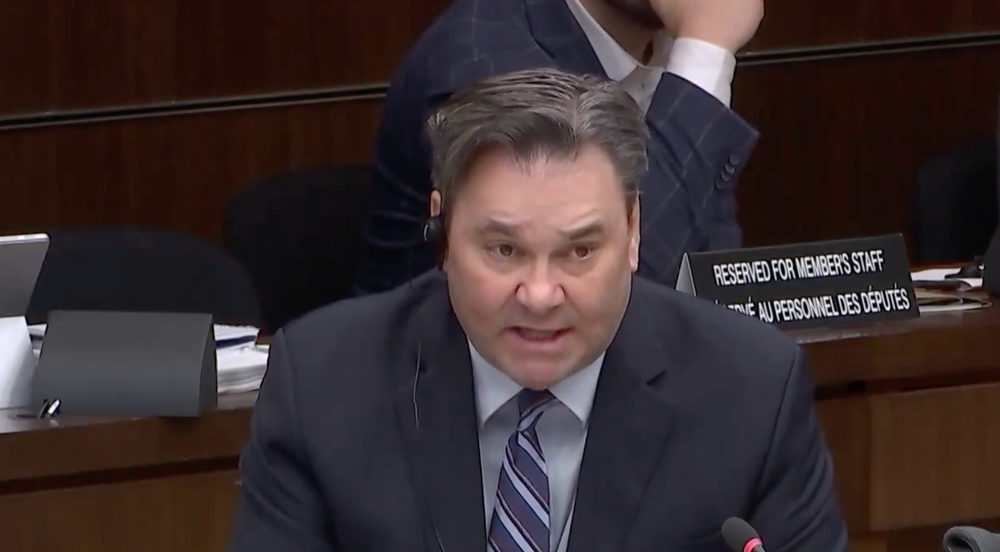
Interim NDP leader Don Davies addresses the House of Commons finance committee to express his objections to Bill C-15. Video credit: Don Davies, Facebook
“In our system of government, Parliament is supreme. That is a foundation of our constitutional system,” Davies told the committee. “I don't think it's an exaggeration to say Bill C-15 contains a serious threat to Canada's democratic foundations.”
At issue are proposed amendments to the Red Tape Reduction Act that would authorize federal ministers to exempt “any individual, corporation, partnership, association or organization” from the application of almost any federal law or regulation.
The only exception is the Criminal Code.
Davies argued this would allow ministers to set aside labour standards, health and safety rules, environmental protections, Indigenous rights, privacy laws, and more “at a minister's discretion.”
Legal experts have begun referring to such provisions as “Henry VIII powers,” a reference to the 16th-century English king who sought authority to legislate without Parliament's consent. The term describes clauses that permit the executive to override statutes passed by the legislature.
Davies rejected government arguments that the measures represent a form of “regulatory sandboxing” controlled environments where businesses can test innovative products with temporary regulatory flexibility.
“This is not regulatory sandboxing,” he said, noting the contrast with narrow, transparent sandbox models used elsewhere. “It is a dramatic departure from the narrow, transparent sandbox models used elsewhere in Canadian and international law.”
The bill's justification for the powers uses broad terms like “competitiveness” and “economic growth,” which Davies warned could be used to suspend almost any law or regulation.
“These provisions in the New Democrats' view do not streamline regulation,” he said. “They erode the rule of law and they create a two-tier system where laws passed by Parliament can be suspended for political convenience, even if they might be otherwise meritorious.”
Critics of this bill have noted that the powers could allow a future government with different priorities to waive environmental assessments for politically connected developers or suspend labour laws for favoured corporations, all in the name of economic growth.
Davies also took aim at the process, arguing the provisions are buried in a 600-page omnibus budget bill rather than being subject to proper scrutiny.
“If the current government truly believes that these extraordinary powers are necessary, they should introduce standalone legislation that can be studied in depth and debated thoroughly,” he said.
Davies called for public, parliamentary examination of any proposed regulatory sandbox provisions, warning that the current approach risks backroom negotiations rather than transparent lawmaking. Prime Minister Mark Carney and his cabinet ministers have not yet provided detailed justification for why such broad powers are needed or why the existing regulatory flexibility mechanisms are insufficient.
Davies concluded his remarks with a direct appeal to fellow committee members: “To protect democratic governance, the rule of law, the constitutional order, and parliamentary supremacy, in our respectful submission, Part 5, Division 5, must be removed from Bill C-15.”
The committee is currently studying the bill clause-by-clause, with amendments expected to be proposed in the coming days. The Carney Liberals holds a minority of seats on the committee, meaning opposition parties could potentially join forces to remove contested provisions.