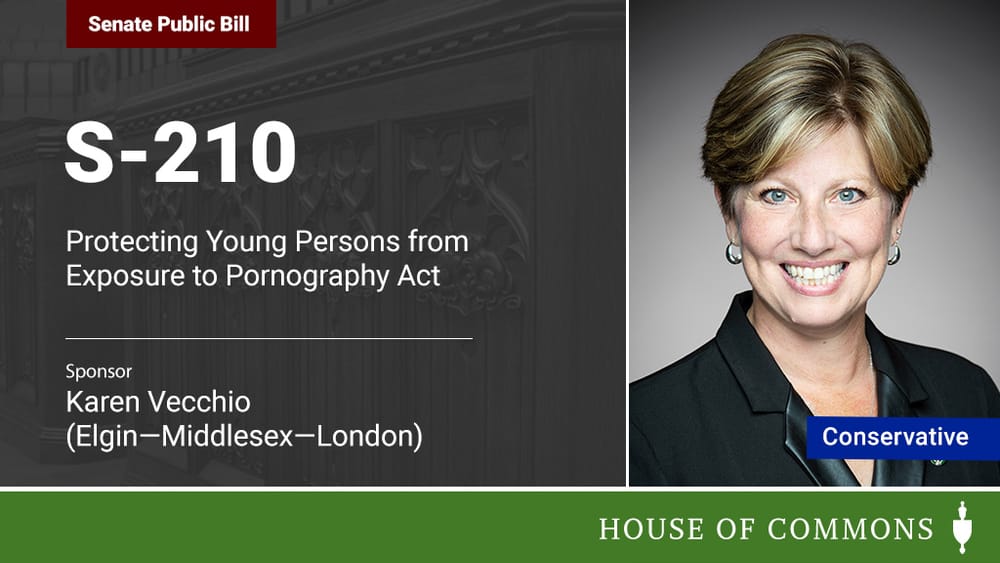
ADAMS: Canada’s Bill S-210 is what happens when security theatre pretends to be parenting
I am sitting here reading Bill S-210, otherwise known as the Protecting Young Persons from Exposure to Pornography Act, and I cannot believe this is something Canadian lawmakers are spending oxygen on. This bill is supposed to protect kids from seeing explicit content online, but the more I look at it, the more it feels like someone stapled a pearl clutch to a legal document and called it a day.
I am watching this unfold in real time, and every page makes me feel like I am reviewing a poorly thought-out cartoon episode where the characters learn the wrong lesson. The central idea behind Bill S-210 is simple. If you want to access a site with adult content, you must prove you are an adult.
That sounds harmless until you remember that the internet is not an LCBO where someone checks your ID at the counter. Age verification online always means two things. Uploading government ID or handing your face over to some camera for age estimation. I view this the same way I view the idea that we should ban Call of Duty because of youth violence. That argument was nonsense then, and it is nonsense now. Youth violence went down during the very years those games became mainstream. The claim was wrong on every metric, but stuck around because it was loud and moralistic and made scared adults feel better.
Bill S-210 is the same brand of security theatre. It is a law crafted for the benefit of people who want the illusion of safety, and in this case, the illusion comes at the expense of privacy and common sense. If your kid has an iPad or a Kindle Fire, I am going to take a wild guess that their parent(s) bought it for them. Which means the government should not have to build an entire surveillance-style apparatus because you as parents refuse to put parental controls on the device you paid for. And I have to say it. When a kid is 15 or 16, this stops being about protecting innocence. By that age, this is just the government interfering with puberty.
Teenagers are curious. Teenagers look things up. Teenagers do not need the feds acting like a guidance counsellor with a clipboard deciding what they can see during the most confusing years of their biological development. So many problems could be avoided if adults actually talked to kids. I mean to them, not at them. Instead, lawmakers decide the correct way to handle this is to treat natural curiosity like a cyber hazard and build a law around it. The more I read the bill, the more problems I see.
First, it never clearly explains what method of verification is required. It just tells websites to verify age. That means any tech company can fill in the blanks however they like. Which means we end up with ID scans, face scans, and third-party verification systems, with companies involved potentially being headquartered in another country with completely different privacy protections. We are talking about uploading legal identification to corporations that may not even operate in Canada. All in the name of a moral panic that collapses if you ask a single follow-up question.
Second, this bill pretends that blocking websites will fix anything. You know what teenagers are really good at? Finding a VPN tutorial. This bill does not stop youth access. It just teaches them how to get around the law. It reminds me of school internet bans that blocked gaming sites but left every proxy website wide open. Gen Z kids bypassed it within minutes because they are digital natives, and the adults writing the rules never are.
And third, it completely ignores how real solutions actually work. If the concern is that children are seeing content they should not, then the answer is education, digital literacy, and yes, parenting. You talk to kids honestly about what they might encounter online. You build trust. You do the hard work adults are supposed to do. You do not build a system that treats every adult like a potential offender and every website like a digital liquor store.
Reading Bill S-210 feels like watching lawmakers sprint toward the most technologically invasive option because it lets them claim victory in a press release. The entire bill is a prime example of confusing action with results. It looks like something is being done. It feels like something is being done. But none of this guarantees the outcome supporters think it will deliver. The only consistent effect is the cost to privacy and the normalization of verification systems that grow more intrusive every year.
So here I am, looking at this bill as it enters committee, and all I can think is that we are building policy around fear and optics instead of evidence or long-term consequences. Kids deserve better than that.
Adults deserve better than that. And the internet absolutely deserves better than another round of political theatre dressed up as urgent moral responsibility.
This piece is an archival work of the author, originally published elsewhere, and is presented here for historical record. The views expressed are solely those of the author and do not necessarily reflect the editorial position of the Provincial Times. Read our Content Policy here.