ADAMS: Why ‘Bowmanville—Oshawa North’ must go
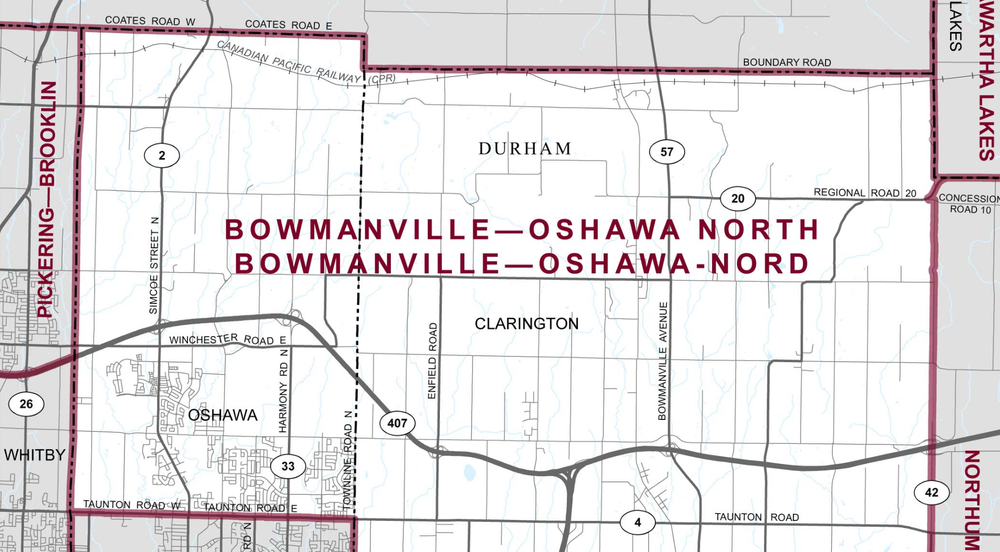
If there is one thing Canadians can agree on in these fractured political times, it is that our federal electoral map should, at the very least, be coherent. The 2025 redistribution was a necessary exercise in democratic maintenance, an attempt to balance populations and ensure representation. But in the eastern exurbs of the Greater Toronto Area, the process has left us with a legacy not of democratic clarity, but of onomastic bloat.
Let us speak plainly: Bowmanville—Oshawa North is a clunker.
It does not roll off the tongue; it falls off it with a thud. The name is a product of the kind of bureaucratic compromise that looks reasonable on a spreadsheet but sounds absurd when spoken aloud. It is an ungainly hyphenate that forces two distinct communities into an awkward syntactical marriage. The rhythm is off. The cadence is that of a legal document, not a proud electoral district. It is a name that invites confusion, not identity.
The broader context is the redistribution that saw the historic riding of Durham, a name with deep regional resonance, split in two. To its east, we were given this new entity. To its west, the commissioners created York—Durham, a name that, while descriptive, at least possesses a certain symmetry. It acknowledges the regional duality while maintaining a clean, recognizable structure. The problem with Bowmanville—Oshawa North is that it prioritizes municipal boundaries over linguistic sense. Bowmanville is a community, not a municipality. Oshawa North (otherwise known as North Oshawa) is a geographic direction, not a place.
Strapping them together creates a name that feels simultaneously too granular and too vague. It is a name that is a chore for pundits to say, a nuisance for journalists to type, and a source of perpetual mild irritation for the residents who must claim it as their own.
There is a better way. In fact, there is an obvious way.
The riding name should be Clarington—North Oshawa.
This refinement follows the exact structural logic of its neighbouring riding, York—Durham. Both would employ the format of Municipality—Geographic Modifier. Clarington is the proper municipal name for the region that includes Bowmanville, lending the riding a formal, coherent identity. North Oshawa is a clean, established descriptor that mirrors the "North" designation in adjacent GTA area ridings, such as Don Valley North and Etobicoke North.
Consider the difference. “Bowmanville—Oshawa North” is a sentence that has lost its way. It forces the speaker to pause, to explain. “Clarington—North Oshawa,” by contrast, flows. It has a natural rhythm. It is easier to say, easier to remember, and crucially, it aligns with the standard of nomenclature used for the other riding born of Durham’s dissolution.
Critics may argue that Bowmanville is the more recognizable name for the riding's eastern portion. But we do not name federal ridings solely by their largest subdivision; we name them for coherence. The riding of Durham was not called "Bowmanville—The Rest." It held a name that signified a region. Clarington is the regional government. Using it grants the constituency a sense of unified purpose, while the “North Oshawa” suffix provides the necessary geographic precision for the urbanized western flank.
This is about more than aesthetics, though aesthetics matter. A riding's name is its brand. It is how constituents identify with their representation. It is how democracy feels to the people living within its lines. A clumsy name breeds a sense of administrative afterthought. A crisp, balanced name like Clarington—North Oshawa confers a sense of place and permanence.
As Parliament is currently considering updates to riding names, it should correct this small but significant error. Let us retire the clunky, hyphenated mess that is Bowmanville—Oshawa North. Let us give the residents of this growing and important region a name that is as functional and dignified as the communities they call home.
Clarington—North Oshawa works. It sounds right. And after the sonic assault of its predecessor, that is more than enough reason to make the change.
The views expressed in this piece are those of the author and do not necessarily reflect the editorial position of The Provincial Times or Left Lane Media Group. Read our Content Policy here.