ADAMS: I Went to the Conservative Convention. Here’s What Really Stood Out.
The BMO Centre on a Thursday afternoon in early 2026 smelled like conference carpet and the particular kind of desperation that sets in when a party has spent six months convincing itself it didn't actually lose.
I know this smell. I've been breathing it for a year now.
I attended the Poilievre rally in Oshawa, where a supporter suggested we hogtie Mark Carney. I sat through the Restore the North event at Canada Christian College where Jamil Jivani stood silent while a woman insisted UN tanks are invading Remembrance Day ceremonies. I watched the Calgary iteration the night before the convention, where a Dominion Society advocate was debated politely, and an anti-abortion activist was publicly shamed for his “weirdo energy.”
So when I walked into the 2026 CPC Convention, I knew exactly what I was walking into.
I just didn't expect them to be this bad at hiding it.
The Polished Veneer
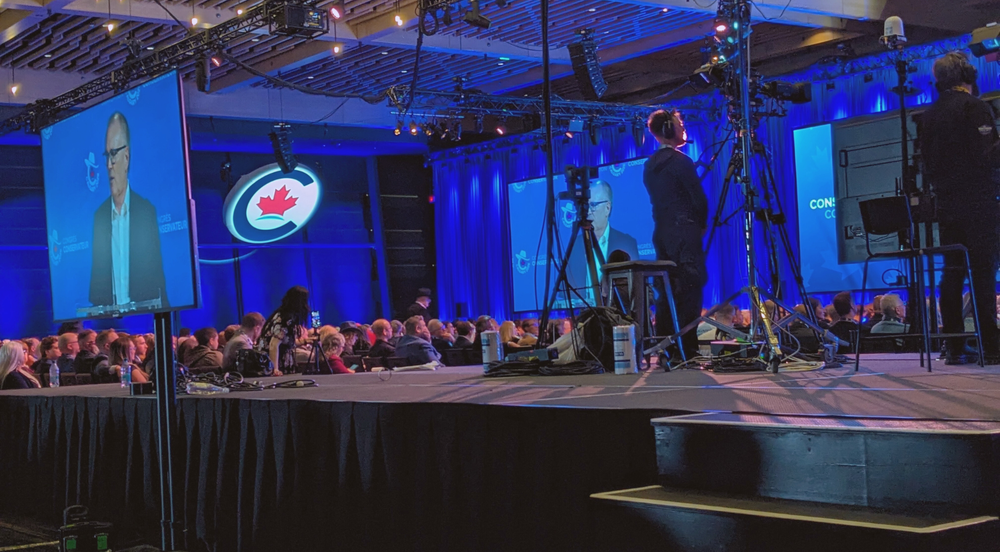
Here's what the official narrative will tell you about the 2026 convention: thousands of engaged conservatives, dozens of thoughtful policy workshops, a leader re-energized and ready for the next fight. The photos will show Pierre Poilievre smiling, shaking hands, performing the role of a man who just led his party to a respectable defeat and is already plotting the comeback.
Here's what the photos won't show:
The national council candidates huddled near the back wall, speaking in the careful, coded language of men who want to criticize the leader without saying his name. We need to decentralize a bit. The tone could use some work. Look at me! theatrics. Every single one of them knew what they were actually saying: Poilievre cost us the election. His shtick played in hangars. It didn't play in swing ridings. And now we're trapped with it.
Then they voted to centralize the party even further.
This is the Conservative Party of Canada in 2026: a room full of people who can diagnose their own disease with surgical precision, and who will, when handed the scalpel, immediately stab themselves in the back.
The Media Card That Wasn't
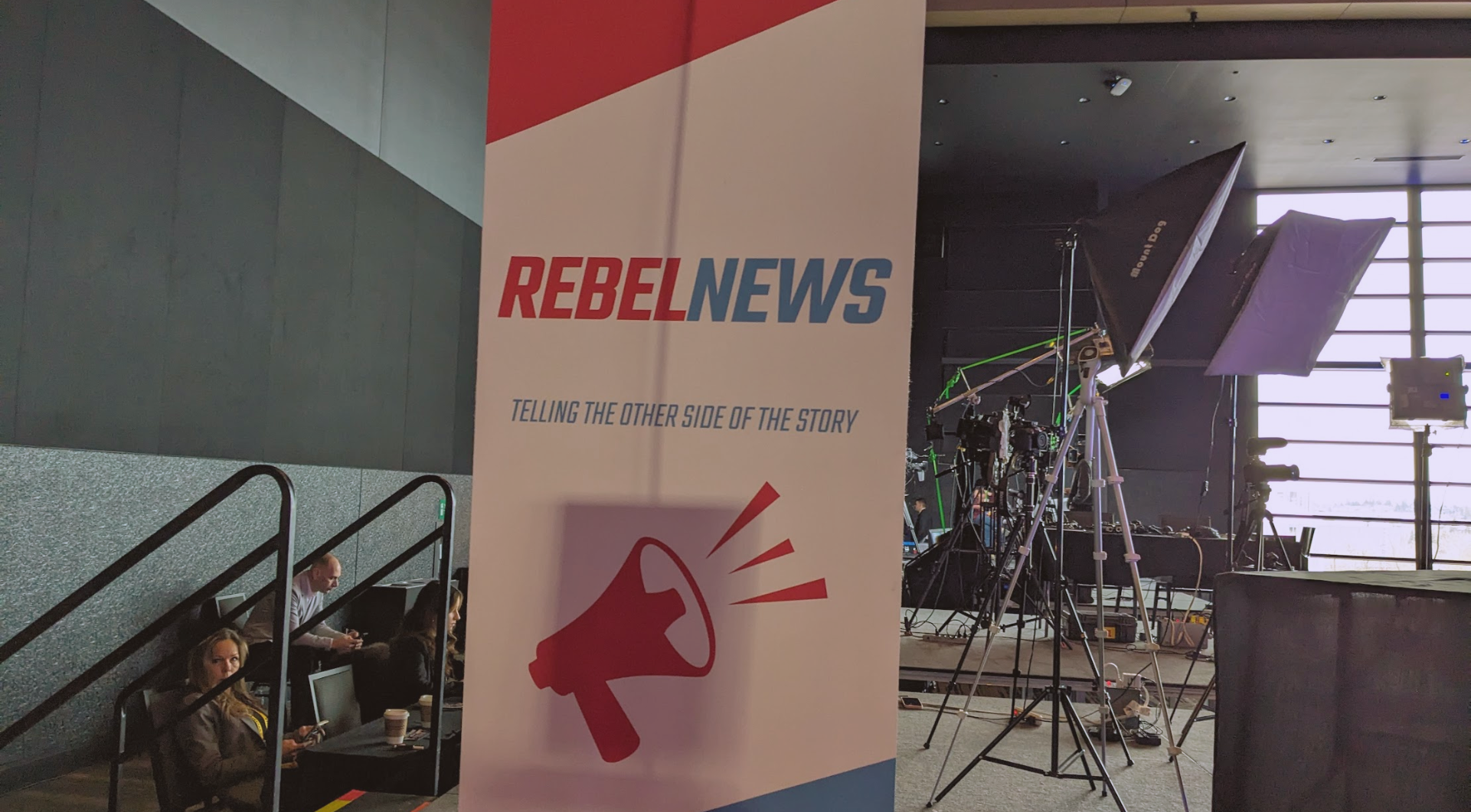
I applied for media credentials two months in advance. The Provincial Times has covered every major Conservative event in the GTA for the past ten months. We've documented the rallies, the campus tours, the fringe, the curation. We've built an archive no one else bothered to build.
Tamara Lich got a badge.
The woman who helped fund a protest that unlawfully occupied Ottawa for three weeks, who became a symbol of extra-parliamentary pressure campaigns, who remains a hero to the countries most radical filaments—she walked the floor with an official credential around her neck.
Dallas Brodie of OneBC walked the floor. Rebel News controlled the media flow. Random social media influencers with four hundred followers were handed “influencer cards” and, in some cases, pre-scripted speeches to deliver from the main stage.
I was told there was no space.
Let me translate: there was no space for anyone who might ask a question the party doesn't want answered.
The Washroom
I used the all-gender washroom at the hotel. I prefer single-person facilities. It's also, frankly, none of your business.
A delegate old enough to be my father watched me walk out and laughed.
“So what's your gender, then?”
Not “what do you think of the leadership review?” Not “first time at convention?” Hell, not even “Hello!” Just immediate, reflexive demand for an accounting of my body. A stranger, emboldened by the room, decided I owed him an explanation.
I didn't give him one.
But I did remember, vividly, the same energy I'd seen at Canada Christian College. The woman who called progressivism a “disease.” The man who said CO₂ at 50,000 ppm “doesn't cause anything.” The absolute certainty that their worldview is the only worldview entitled to exist in public space.
And I remembered what Jamil Jivani did at that event: nothing. He validated. He nodded. He lent credibility.
The man in the hotel hallway is the logical endpoint of a movement that has spent four years telling its base that their unmediated instincts are not just acceptable, but righteous.
"Billboard Chris" And The Bitch Stare
I found Chris Elston, AKA "Billboard Chris," the man who travels the country obsessing over the genitles of children he doesn't know, and also feels that trans people shouldn't be teachers. On day two, I saw him, standing near the escalators like he was waiting for someone.
I walked up to him.
I asked, as neutrally as I could manage, whether he had made his comments about trans teachers before or after Samantha Fulnecky admitted to fabricating her high school essay story.
He gave me the bitch stare.
Not a response. Not an argument. Just a long, silent, contemptuous look that said you are not entitled to my engagement.
I said: “I don't agree with you. I think you're wrong.”
He said: “Okay, thanks.”
Then he looked away.
This is the free speech warrior in his natural habitat: absolutely unwilling to exchange two sentences with someone who disagrees with him. He wasn't there to debate. He was there to perform, to be seen, to occupy space and call it discourse. The moment a real conversation presented itself—one where he might have to defend his positions rather than simply assert them—he retreated into passive aggression and hoped I'd go away.
I went away. Not because he won. Because there's no point in demanding water from a stone.
The Conversations That Mattered
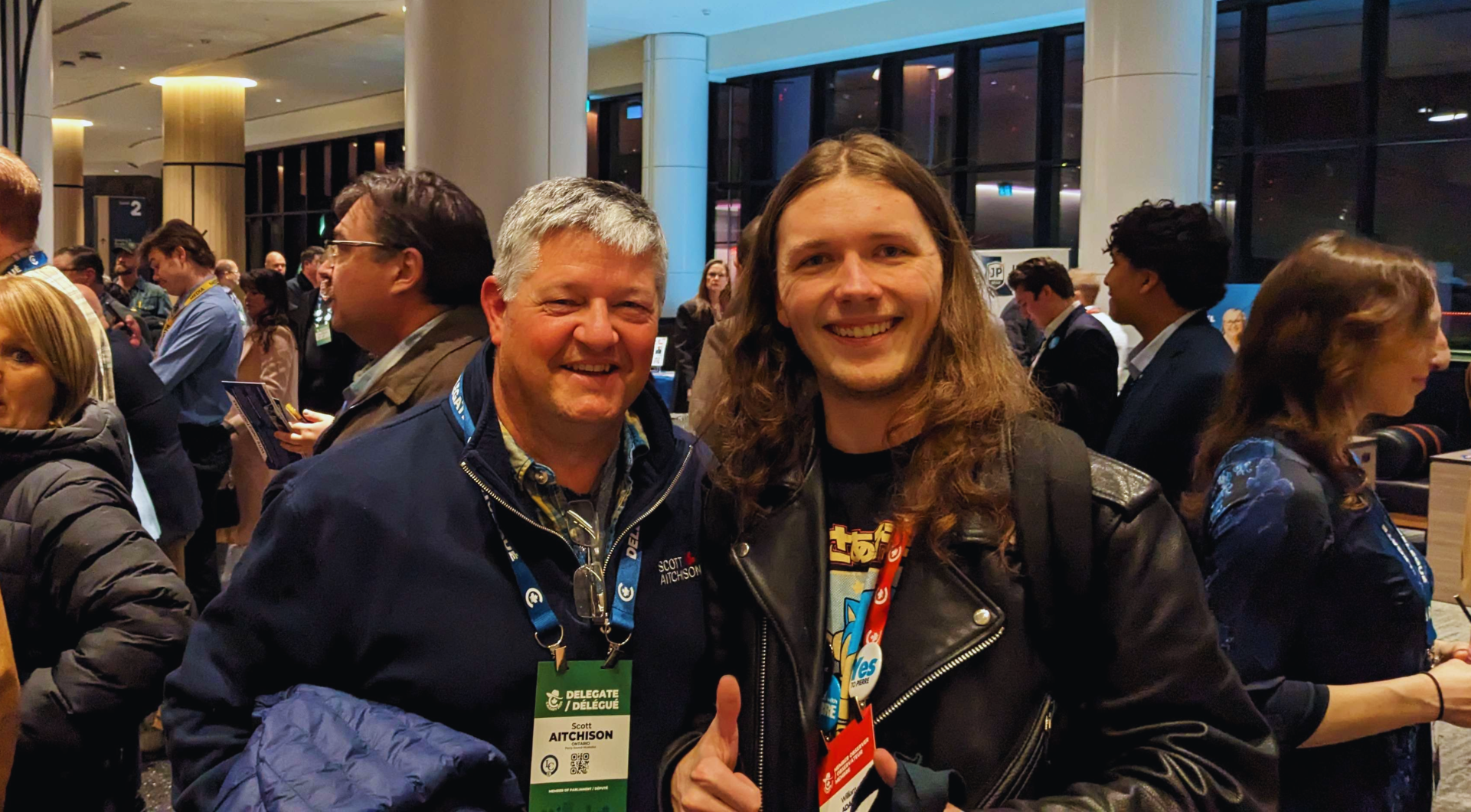
I spoke to MPs on all three days. Some of them I sought out. Some of them approached me, because I was wearing CPC merch and I'd learned to modulate my affect into something approximating insider comfort.
Don Stewart and I discussed the Longest Ballot initiative. I told him about my attempt at running as a protest candidate in 2025, the sheer grind of collecting signatures, the insult of watching these vanity campaigns treat democratic participation like a cosplay competition. He listened. We talked about Israel. He described Jerusalem as “beautiful, unlike anything I've ever seen.” I believe him.
Scott Aitchison and I spoke on every single day of the convention. This is a man who ran for party leadership explicitly because of “tone,” his word, not mine. He told me, without prompting, that he finds the anti-LGBTQ rhetoric appalling, that the anti-abortion absolutism is “ridiculous,” that the Erin O'Toole's and Jean Charest's were the leaders this party should have chosen.
I respect Scott. I also watched him walk back into a building where his party just voted to affirm that conversion therapy is acceptable when applied to transgender youth, and I haven't heard him say a word about it.
Michelle Ferreri seemed genuinely warm. I made small talk, got cold feet, and she compensated for my awkwardness with unstudied kindness. She was not a problem.
Branden Leslie laughed with me about his by-election victory, the one that supposedly was going to be a nail-biter against Maxime Bernier and ended as a rout. He called Bernier a grifter without hesitation. He told me, offhandedly, that Chris d'Entremont crossed the floor not out of conviction but out of pique; angry for a month about not getting deputy leader, seizing on Michael Ma's floor-crossing as an excuse to vent this. Ma was elected under Poilievre.
Damien Kurek told me, with absolute certainty, that he will run in Battle River—Crowfoot in 2029. The establishment respects its voters, clearly. They just don't respect anyone else.
Garnett Genius was the least fond of me. I asked why he tables at York University when his seat is in Alberta. He gave me the standard answer: spreading awareness. I asked why he does it in Ontario. He “saw a friend” and excused himself.
The Favourite Leader Question
I asked every MP I spoke to the same question: Who's your favourite leader from Harper to Poilievre?
Most gave the politician's answer: vague, inclusive, and allergic to hierarchy.
“All were good in their own way. Each brought something different. We've been blessed with strong leadership.”
But some answers deviated from this formula.
- Branden Leslie said Candice Bergen.
- Scott Aitchison said Erin O'Toole. Then: “Jean Charest, if the PCs counted.”
- Damien Kurek said Pierre Poilievre and laughed.
- Andrew Scheer said himself. Then he laughed too.
These are not betrayals of confidence. These are men who, when asked a simple, human question, answered honestly. And their honesty reveals something the party would prefer to obscure: even among its own elected officials, the consensus on Poilievre is not nearly as solid as the floor votes suggest.
They will vote for his leadership. They will applaud his speeches. They will tell the media he's the right man for the job.
And then, in the hallway, they will name almost anyone else.
Harrison Faulkner And His Demonic Statues
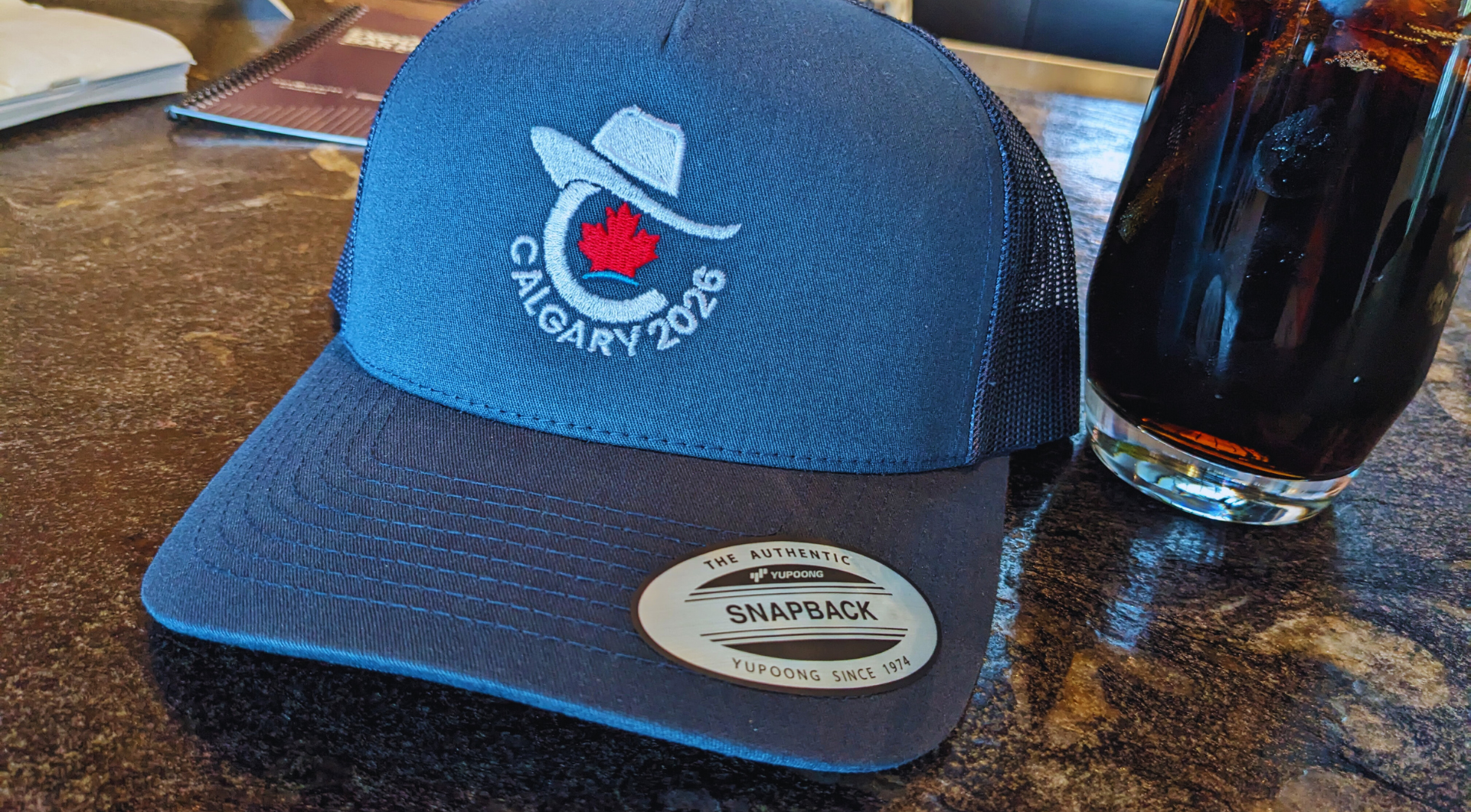
I ran into Harrison Faulkner near the bar on the second floor. I was drinking Coke—genuinely thirsty, not performing anything. He was sitting right next to me, doing whatever Harrison Faulkner does when the cameras are off.
I said, sarcastically, that I loved his video on Brampton. I said I found it “very educational.”
He couldn't tell I was being sarcastic.
This is not a dig at his intelligence, more of an observation about his environment: Harrison Faulkner exists in a media ecosystem where sincere praise and sarcastic critique are delivered in exactly the same register. His supporters actually do talk that way. They actually do tell him his work is educational. The signal-to-noise ratio has collapsed so completely that irony has become indistinguishable from endorsement.
We talked for fifteen minutes.
He said the Buddhist statues in Brampton are incongruent, aesthetically jarring, and most notably, “demonic.” We debated, without hostility, the Charter of Rights and Freedoms. He was genuinely engaged. I was genuinely engaged. For a brief moment, we were just two people arguing about what we believe Canada should be.
Then he went back to his people and I went back to drinking Coke by myself.
I keep thinking about that word. Demonic. Not a critique. Not an opinion. A spiritual diagnosis. This is where the Overton Window has relocated: not just policy disagreement, but cosmic condemnation of your neighbour's religious expression.
And the party leadership? They're not condemning it. They're not even acknowledging it. They're just hoping you don't notice the guy in the corner calling your place of worship a portal to hell.
One, Two Narratives Kneel Before You
Here's what I heard, over and over, from the grassroots:
Zoomers can't find work because the TFW program is stealing their jobs.
Zoomers are lazy and don't want to work.
These two statements coexisted in the same conversations, sometimes in the same breath. A woman spent ten minutes telling me about her nephew who's “mutilating” his children by supporting their transition, then pivoted seamlessly into a rant about how young people expect everything handed to them.
According to the radical right: I am being replaced, but I am also just refusing to work. I am a victim, but I am also entitled.
Sorry, but no. It can't be both.
Unless, of course, the goal isn't coherence. The goal is to have a grievance available for every occasion. When you need to attack immigration, we're being stolen from. When you need to attack welfare, we're lazy. The subject—young people—aren't actually the subject. We're just the terrain on which the real battle is fought.
I told the man in line for Poilievre's speech that some people vote Liberal or NDP because the Conservatives don't represent their values. He told me I was giving too much good faith to people who wouldn't return it.
I told him the Tories need to meet people where they're at.
He told me to keep an open mind.
The irony was not detected.
The Conversations I Haven't Had Yet
A member of the University of Calgary Young Conservatives found me on day three. He knew who I was. He'd been at the Restore the North event three nights prior, the one where Danielle Smith stood on stage and Jamil Jivani ejected the “weirdo energy” guy while calmly weaving anti-trans rhetoric into a speech about helping young men.
He asked me why I do what I do.
I told him. I said I'm not a Tory because the social conservatism alienates me. I said I find the rhetoric around transgender people cruel and indefensible. I said the party's position on abortion—whatever Jivani claims about not wanting to “tear the country apart”—is held hostage by a faction that believes half the population should lose control of their own bodies.
He asked why I haven't said any of this at Restore the North.
Not if I will. Why haven't you.
I told him I have a formula. I said I ask the questions I think I can get answered, the ones that build credibility, the ones that establish me as a serious interlocutor rather than an agitator. I told him I'm waiting for the right moment.
He said, fairly: “When is that?”
I patted him on the shoulder and said; “you'll see.”
The Staffer Who Blushed
I've known one of Jamil's staffers for years. Not well, but well enough. We went to high school together. We've been in the same rooms. He knows I'm not a Conservative. I know he's not stupid.
At the convention, I asked him about something I'd discovered in the course of an ongoing investigation—a detail I'm not ready to publish yet, but that involves his volunteer work in Erin O'Toole's own riding during a period when he was definitely not supposed to be volunteering for the PPC.
I didn't accuse him. I didn't confront him. I just described a man who looked very much like him, doing a thing I knew he'd done, and asked if he knew who that might be.
He blushed.
Not a subtle flush. A full, immediate, cannot-control-my-capillaries crimson. The kind of physiological response that precedes a confession, or a lie, or both.
For the rest of the convention, whenever he saw me, he would literally look over his shoulder to see if I was following him.
I wasn't.
But he didn't know that. And his anxiety told me everything I needed to know about whether my investigation was on the right track.
The Policy Void
Let me be precise about what was not happening at this convention.
There were policy workshops. There were resolutions. There were earnest delegates with binders full of amendments. But there was no serious reckoning with the central question the 2025 election posed: Why did a party that spent four years leading in the polls, that mobilized a youth movement unprecedented in modern Canadian conservatism, that had an incumbent government exhausted and vulnerable—why did that party lose?
The answers on offer were:
- The Liberals cheated.
- The CBC was biased.
- Mark Carney lied.
- We didn't centralize enough.
Notice what's missing.
- Not: our leader's tone alienated moderates.
- Not: our policy platform was slogans and oil.
- Not: our coalition includes people who believe Buddhist statues are demonic, UN tanks are invading, and “remigration” is a legitimate policy framework.
- Not: we platformed a candidate who mocked LGBTQ Americans fearing for their rights under a second Trump administration, and we made him a senator.
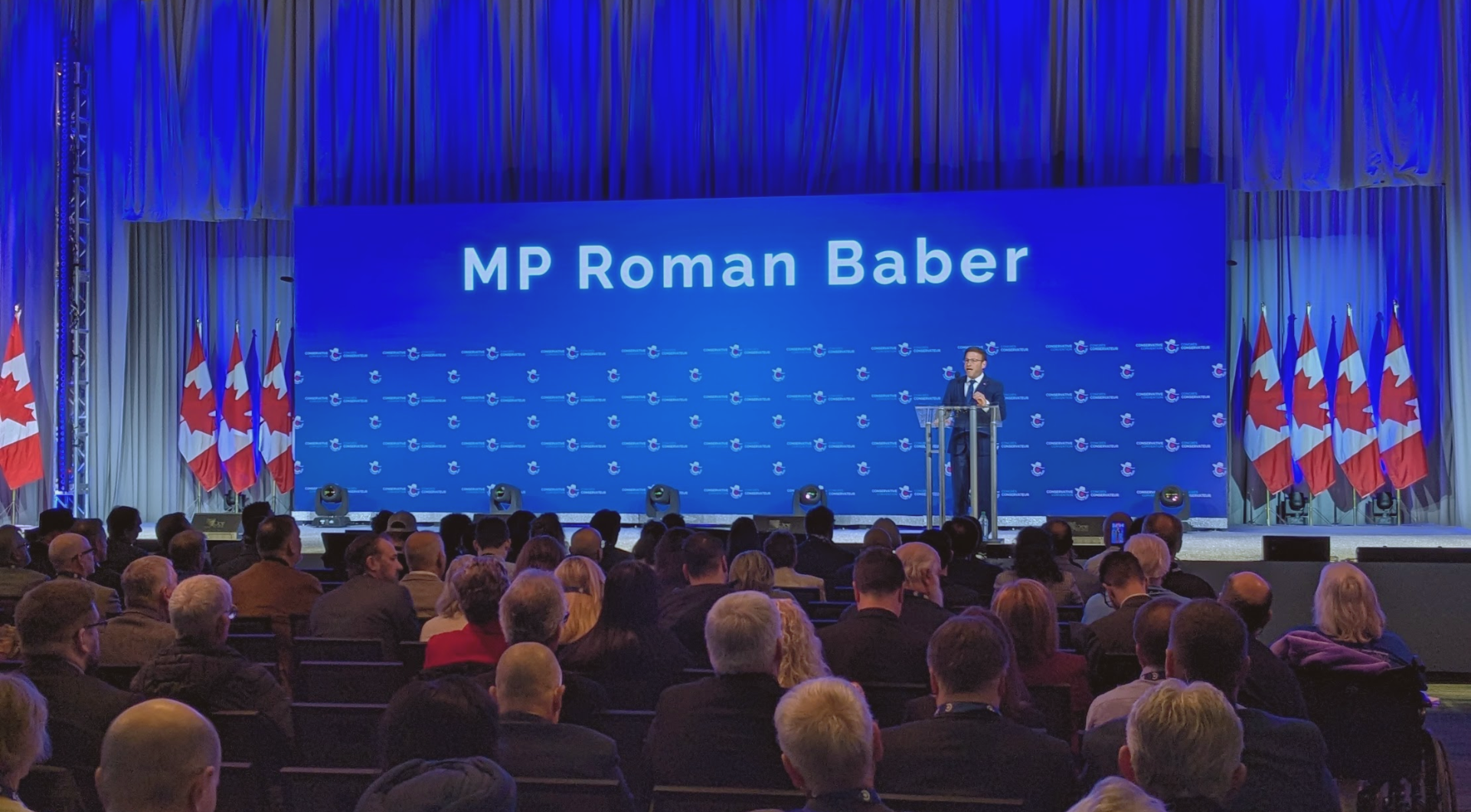
For context on that last point; Roman Baber was at this convention. I spoke to a Jewish gentleman who worked for him, who told me—off the record, with no evidence beyond a selfie proving their professional relationship—that Baber mocked women and LGBTQ Americans who were genuinely terrified about their legal status post-2024. Made jokes about them. Found their fear amusing.
I don't know if this is true. The man offered no proof beyond his own testimony. But I do know that Roman Baber is now a Conservative MP, and I do know that no one at this convention seemed particularly bothered by that fact.
The Canada Conservative Women's Association
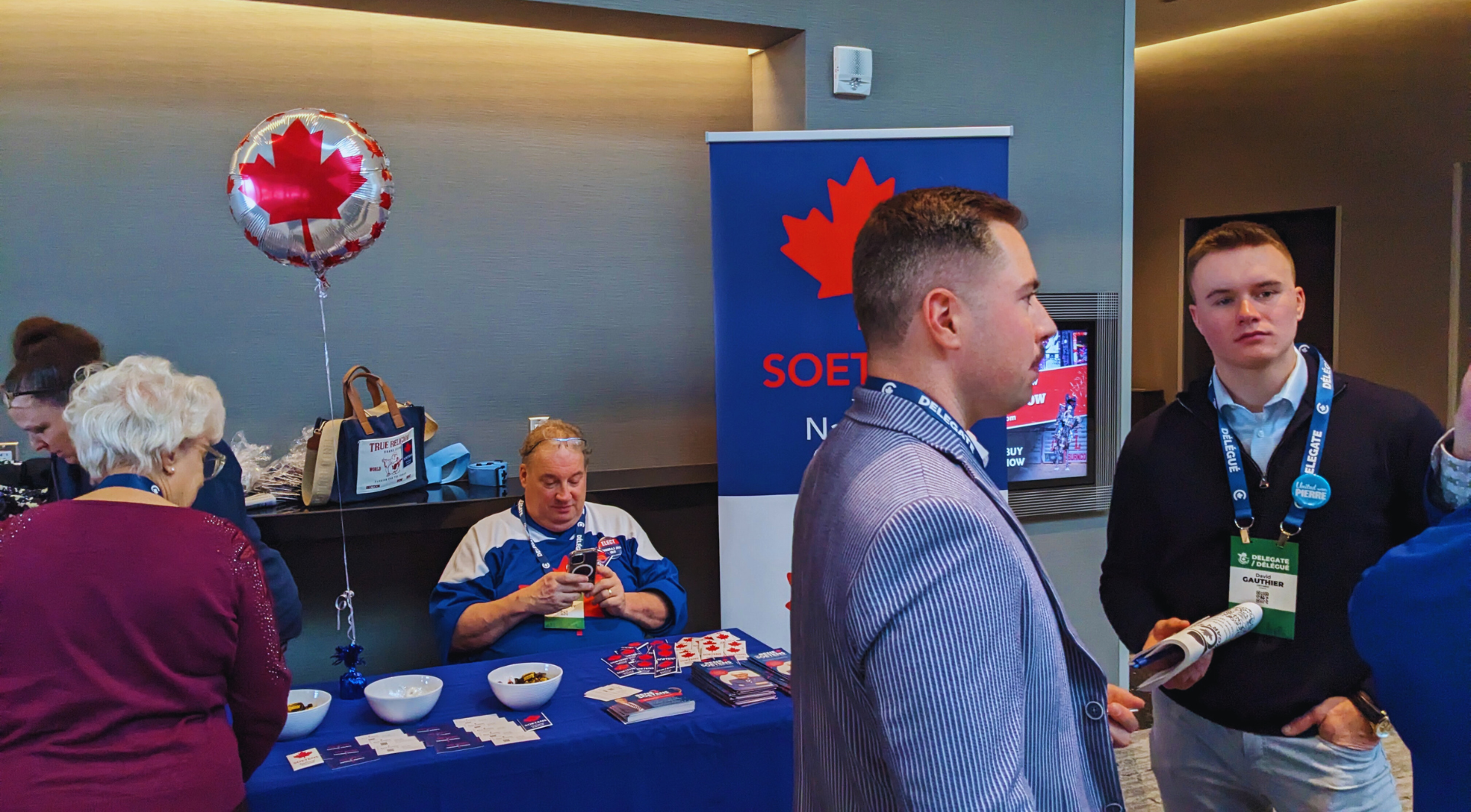
The Canada Conservative Women's Association had a table near the back. They were giving out t-shirts. I took one. They seemed genuinely nice.
Their stated mission: help Poilievre win a majority by targeting the largest voting bloc with which he is currently radioactive.
They had no answer when I asked how they plan to do that.
But they were nice. I mean that sincerely. They smiled, they handed me a shirt, they didn't demand my gender identity or accuse me of being replaced by TFWs. It was the most pleasant thirty seconds of my convention experience.
I am holding onto this.
What I Learned In Calgary
I came to Calgary expecting to confirm my thesis. I left with something more complicated.
The Conservative Party of Canada in 2026 is not out of control. It is not a chaotic collection of angry voters and opportunistic politicians. It is a machine that knows exactly what it's doing.
It knows that Billboards Chris cannot be debated, only endured.
It knows that Harrison Faulkner cannot detect sarcasm because his media environment has rendered irony obsolete.
It knows that the washroom guy will keep demanding accounting of strangers' bodies, and that this will cost them elections, and that they cannot stop him without alienating the voters they need to win.
It knows that Scott Aitchison will stay, even though he knows better, because leaving means ceding ground to people who don't believe he should exist in the party at all.
It knows that Branden Leslie will call Maxime Bernier a grifter and then vote with the party that platformed him in the first place.
It knows that I am wearing their merch and asking their MPs about their favourite leaders and building an archive they cannot control.
It knows all of this. And it does not care.
Because the Conservative Party of Canada is no longer designed to win elections. It is designed to sustain itself.
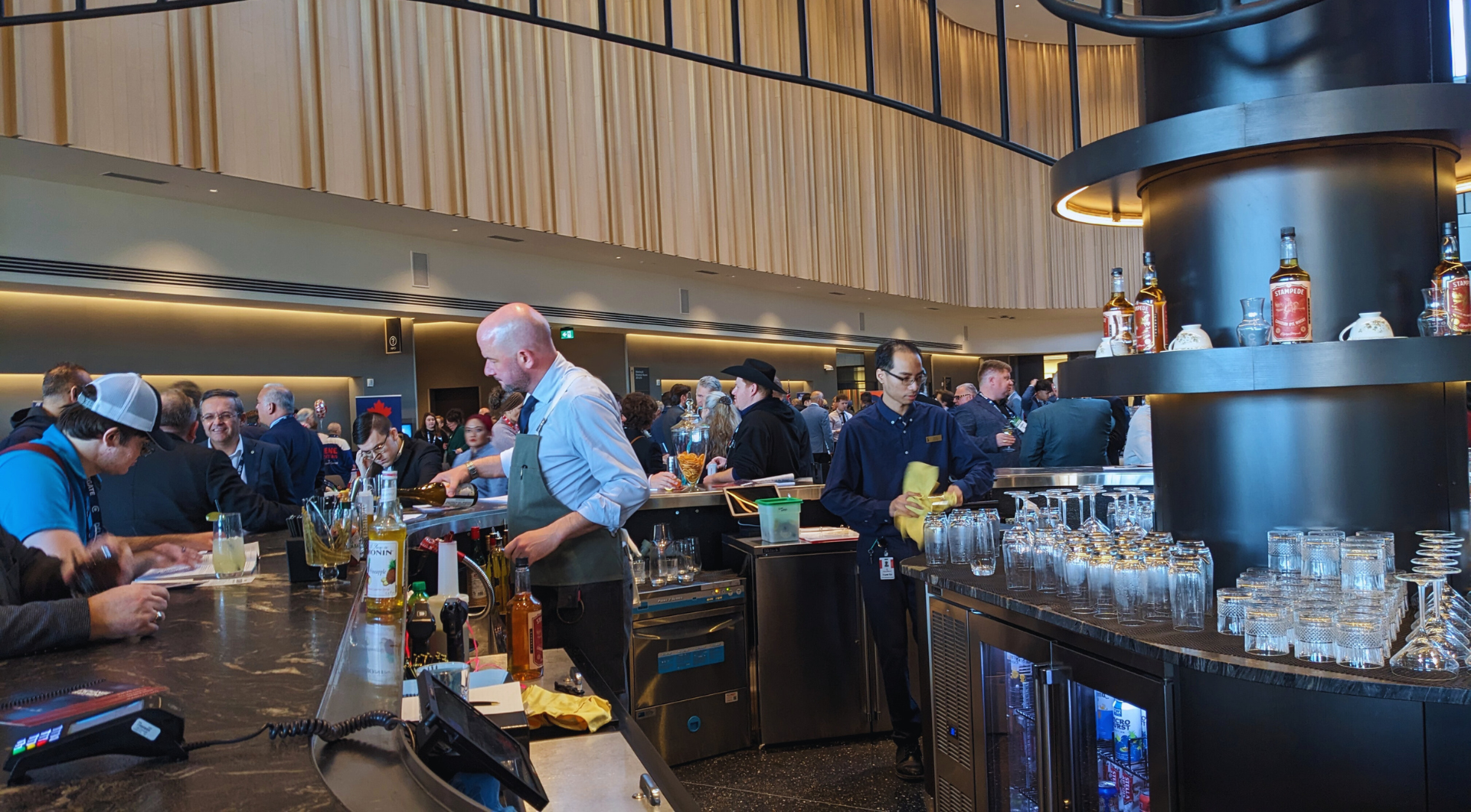
Every election loss, the fundraising continues. The merch sells. The influencers get their pre-scripted speeches. The hats remain on twenty percent of attendees. The machine consumes the energy of young people who are genuinely desperate for someone to acknowledge their economic reality, and it outputs slogans.
It consumes the expertise of MPs who know exactly what's wrong with the tone, and it outputs centralization. It consumes the goodwill of voters who show up, ask questions, wear the merch, try to engage, and it outputs the bitch stare.
This is not a movement.
This is a maintenance regime.
Final Thoughts
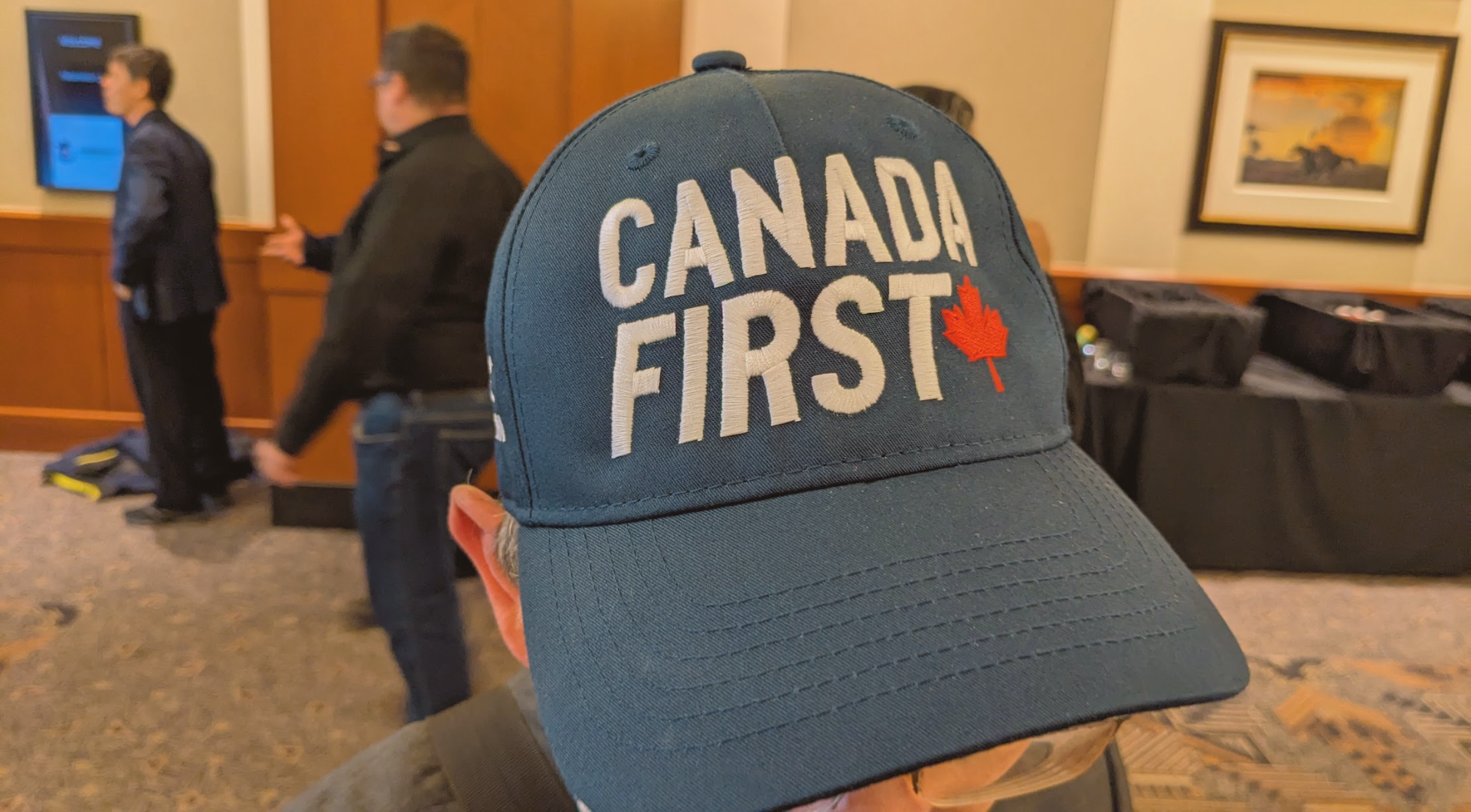
While on my layover from Edmonton to Pearson, I sat in the airport, still wearing the CPC merch I'd been wearing for three days. A man in a “Canada First” hat walked past me, recognized me from the audience at Calgary, nodded. I nodded back.
We did not speak.
I don't know what he believes about UN tanks or Buddhist statues or the gender identity of strangers. I don't know if he's one of the twenty percent who sees the curation clearly, or if he's just there because someone finally told him his economic despair was real and he hasn't yet realized the solutions are fiction.
I don't know if he'll still be wearing that hat in 2029.
I don't know if I'll still be attending these events in 2029.
I do know that the machine will still be running. The merch will still be selling. The influencers will still be reciting their pre-scripted speeches. The MPs who know better will still be staying.
And someone will still need to document it.
I'll be here.
The Provincial Times’ coverage of the 2026 Calgary Conservative Convention was made possible thanks to the support of readers like you. If you believe in independent, reader-funded journalism, we encourage you to donate to our donation page. Thank you for all your support!