
ADAMS: With a straight face, could Poilievre or Singh have taken that stage?
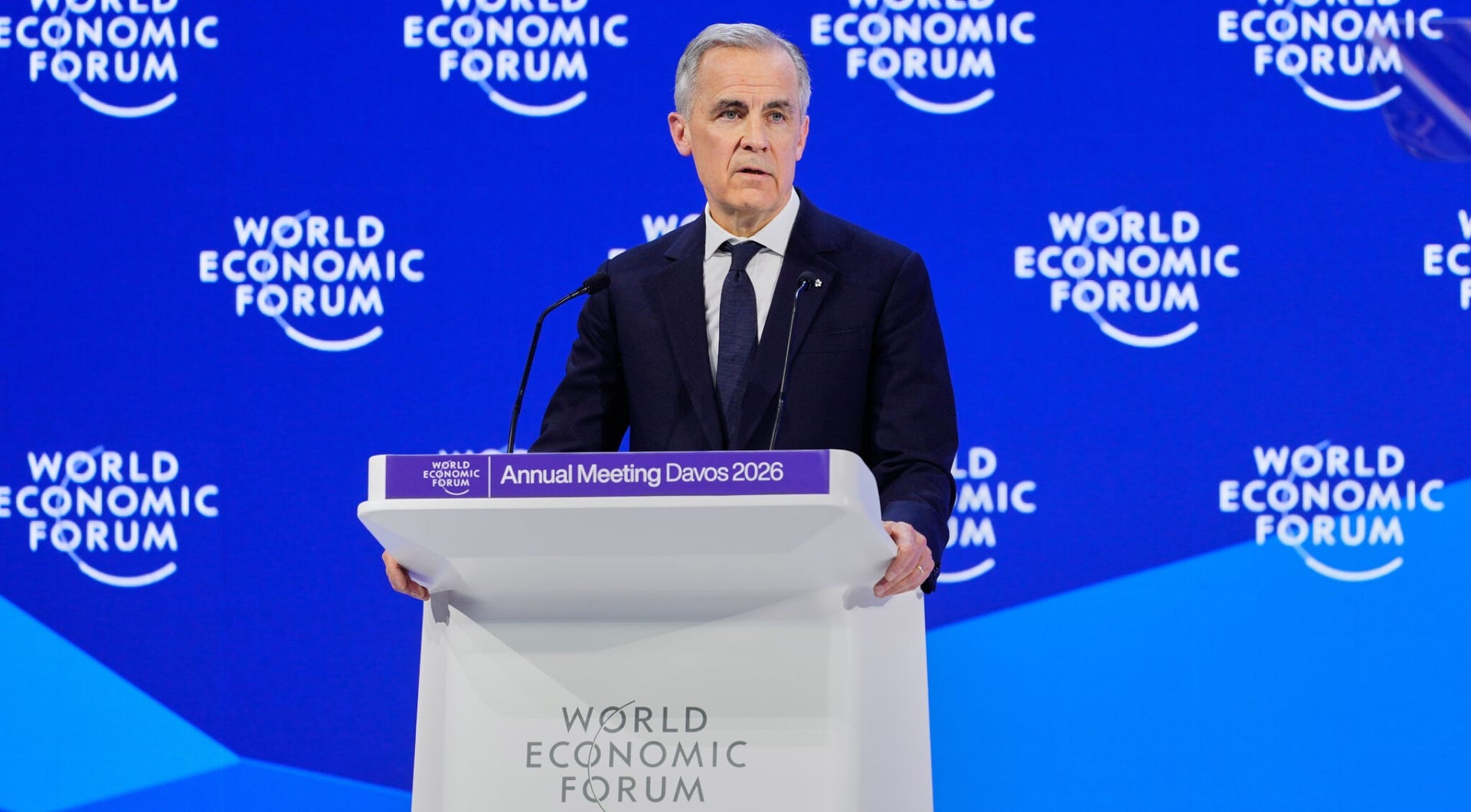
I’m writing this as a preface to an op-ed detailing my further thoughts on Mark Carney's speech at the World Economic Forum in Davos.
Not because I'm suddenly starstruck by foreign policy speeches or suspended my criticisms of Carney's government, and certainly not because I think one speech absolves anyone of scrutiny.
I'm writing because the Davos address is evidence of something, and pretending otherwise would require an impressive level of self-deception.
So let me pose a simple question to voters. Not a gotcha. Not an insult. An honest question:
Could you say, with a straight face, that you could have seen Pierre Poilievre or Jagmeet Singh delivering that speech, in that room, at that moment in history?
No. You can't.
And anyone who says otherwise is either ignorant of context or lying to you.
Let's dispense with distractions first.
Yes, Pierre Poilievre once said he would ban a hypothetical Canadian government from attending the World Economic Forum. That was nonsense then, and it's nonsense now. Canada has participated in Davos for decades without incident. Even Maxime Bernier, hardly an internationalist caricature, attended without confederation collapsing.
Yes, Jagmeet Singh has a WEF profile page, as do countless politicians, activists, and labour leaders.
Let's set all of that aside. None of it matters.
The question is not attendance.
The question is credibility.
Davos is not a campaign rally. It is not a partisan audience. It is not a room where slogans are rewarded. It is a room where people who control capital, trade flows, defence procurement, and state capacity assess whether you understand the world as it actually exists.
That is why the Carney speech mattered—because it demonstrated competence in context.
Carney did not pretend the post-WWII order was coming back. He did not perform nostalgia. He did not speak in absolutes or fantasies. He acknowledged rupture. He acknowledged power. He acknowledged limits.
That is what leadership sounds like when the audience cannot be bluffed.
Now ask yourself—honestly—what would have happened had Poilievre taken that stage.
He would not have gone to begin with, and that's assuming he had even been elected, which itself requires a suspension of disbelief. But even if you indulge the hypothetical, it collapses immediately. The antagonistic, far-right populism that plays on social media does not translate into a room of sovereign nations, central banks, and security alliances.
In this scenario, “Prime Minister Poilievre” would be laughed off the stage within seconds.
And Singh? Singh would not have even been laughed at; he would have just been ignored. The WEF does not reward moral posturing detached from reality. It does not respect ambiguity disguised as legitimate policy.
Keep in mind, I did not vote for Carney because of foreign policy.
I voted for Carney because housing supply is a material crisis, and slogans do not pour concrete. On that end, Build Canada Homes is a good solution to this problem on paper. That was my priority, and I voted accordingly. Others had different ones. That does not make them stupid, immoral, or unserious. But I am not a fool.
Anyone who solely cared about an increasingly authoritarian Washington, about trade weaponization, about the collapse of multilateral guardrails—anyone who understood that foreign policy had become domestic policy by other means—voted for Carney on that file.
And many did so reluctantly.
Long-time Conservatives who could not stomach Pension Poilievre's unseriousness and New Democrats who understood that hollow Jagmeet Singh's protest politics do not function in a fractured world delivered Carney the popular vote in April 2025.
Does this mean you were wrong if you didn't vote on that basis? No.
Does it mean you must now agree with everything Carney does? Absolutely not.
But it does mean this: no voter honestly believed Poilievre or Singh could do this specific job, in this moment, on this stage.
Entertaining that idea was never a serious analysis. And the Davos speech removed any remaining ambiguity. This is evidence that leadership is not interchangeable.
You don't have to like Carney.
But if you're honest—with yourself, if not with others—you already know the answer to my question.
And that is why this moment mattered.
This piece is an archival work of the author, originally published elsewhere, and is presented here for historical record. The views expressed are solely those of the author and do not necessarily reflect the editorial position of the Provincial Times. Read our Content Policy here.

Comments